The factory floor has changed. What once relied on manual oversight, fixed schedules, and reactive maintenance is now evolving into something far more adaptive. In 2026, manufacturers are not just producing goods; they are orchestrating data, machines, and decisions in real time. This shift is what defines smart manufacturing.
As global competition intensifies and margins tighten, factories are turning to intelligent systems that respond dynamically to demand, disruptions, and performance signals. The result is a new operating model often described as dynamic manufacturing, built to address the most pressing manufacturing industry challenges in 2026.
What Is Smart Manufacturing?
Intelligent manufacturing refers to the integration of digital technologies, data analytics, automation, and connected systems across the manufacturing value chain. The goal is to create factories that are self-aware, adaptive, and continuously improving.
Unlike traditional automation, intelligent manufacturing systems do not operate in isolation. Machines, software platforms, and human operators are connected through data, allowing decisions to be made based on real-time insights rather than historical reports.
According to the World Economic Forum, smart manufacturing enables factories to improve productivity by up to 30% while reducing downtime and operational waste.
From Static to Dynamic Manufacturing Models
Traditional manufacturing systems are static. Production plans are fixed, maintenance is scheduled, and deviations are handled manually. In contrast, dynamic manufacturing adapts continuously based on real-world conditions.
Dynamic manufacturing systems can:
• Adjust production schedules based on demand signals
• Predict equipment failures before they occur
• Reallocate resources during disruptions
• Optimize energy usage automatically
This shift allows factories to respond faster to market changes and supply chain volatility, which has become critical in recent years.
A McKinsey study found that manufacturers adopting dynamic, data-driven production models can reduce operational costs by 15–20%.
Manufacturing Industry Challenges in 2026
The push toward smart manufacturing is driven by a set of structural challenges facing the industry.
Key Manufacturing Industry Challenges in 2026
• Rising operational and energy costs
• Global supply chain disruptions
• Skilled labor shortages
• Equipment downtime and aging infrastructure
• Increasing sustainability and compliance pressures
• Demand volatility and shorter product lifecycles
According to Deloitte, nearly 70% of manufacturers cite workforce shortages and operational inefficiencies as their top constraints heading into 2026.
Smart manufacturing directly addresses these challenges by improving visibility, automation, and predictive decision-making.
Core Technologies Powering Smart Manufacturing
Smart manufacturing is not a single solution. It is an ecosystem of technologies working together.
1. Industrial IoT (IIoT)
Sensors and connected devices collect real-time data from machines, tools, and production lines. This data forms the foundation of smart manufacturing by providing visibility into operations.
IIoT enables:
• Real-time equipment monitoring
• Condition-based maintenance
• Production tracking and quality control
According to IBM, IIoT-driven manufacturing environments can reduce unplanned downtime by up to 50%.
2. Advanced Analytics and AI
Data alone is not enough. Smart manufacturing relies on analytics and AI to convert data into insights.
AI systems are used for:
• Predictive maintenance
• Demand forecasting
• Quality anomaly detection
• Process optimization
PwC reports that AI-driven manufacturing systems can increase productivity by up to 20% while reducing defect rates.
3. Manufacturing Execution Systems (MES)
MES platforms act as the operational layer between ERP systems and the factory floor. They provide real-time control over production processes.
Key MES capabilities include:
• Work order management
• Production scheduling
• Quality tracking
• Traceability and compliance
MES plays a critical role in enabling dynamic manufacturing by synchronizing plans with actual execution.
4. Digital Twins
Digital twins create virtual replicas of physical assets and production systems. These models allow manufacturers to simulate scenarios, test changes, and predict outcomes before making real-world adjustments.
Benefits include:
• Reduced downtime
• Faster process optimization
• Better capacity planning
According to Accenture, digital twin adoption can improve operational efficiency by up to 25% in manufacturing environments.
5. Robotics and Intelligent Automation
Modern robotics is collaborative, flexible, and AI-enabled. They work alongside humans rather than replacing them outright.
Smart automation supports:
• Precision manufacturing
• Hazardous task reduction
• Consistent quality output
The International Federation of Robotics reports steady global growth in industrial robot adoption as manufacturers pursue automation resilience.
Table: Traditional Manufacturing vs Smart Manufacturing
| Area | Traditional Manufacturing | Smart Manufacturing |
|---|---|---|
| Decision Making | Manual, reactive | Data-driven, predictive |
| Maintenance | Scheduled | Condition-based |
| Production Planning | Fixed | Dynamic and adaptive |
| Visibility | Limited | Real-time |
| Scalability | Rigid | Flexible and modular |
Visual Flow: How Smart Manufacturing Systems Work
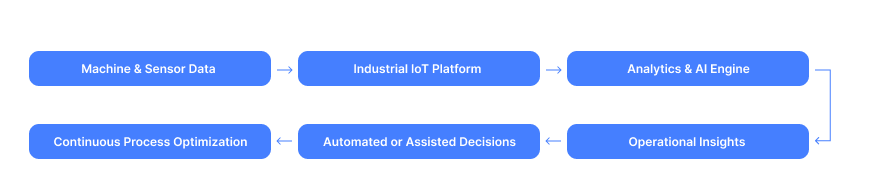
This closed-loop system allows factories to learn and improve continuously rather than relying on periodic reviews.
Why Smart Manufacturing Is a Strategic Imperative
Smart manufacturing is no longer optional for factories aiming to remain competitive. It enables faster response to disruptions, better resource utilization, and improved customer satisfaction.
Manufacturers investing early in intelligent systems are better positioned to:
• Scale operations sustainably
• Reduce operational risk
• Meet regulatory and sustainability targets
• Compete in volatile global markets
According to BCG, smart factories outperform traditional ones on productivity, resilience, and long-term profitability.
Conclusion
Smart manufacturing represents a fundamental shift in how factories operate. By combining connected systems, real-time data, and intelligent automation, manufacturers can move from reactive operations to proactive, adaptive production models.
As manufacturing industry challenges in 2026 continue to evolve, factories that embrace dynamic manufacturing and invest in the right technologies will not only survive but lead. Smart manufacturing is not just about efficiency; it is about building factories that can think, respond, and grow in an unpredictable world.