
Share with your community


“Zoho vs Salesforce” isn’t a fair fight if you compare them like two versions of the same product, because they aren’t. Salesforce is built to scale into complexity. Zoho is built to get a team running fast without a specialist on staff to keep it running. Most comparisons pick a side and dress it up as balanced. This one won’t. Below is what actually separates the two platforms in 2026: real pricing, where Salesforce genuinely wins, where Zoho does, and the one question that matters more than either platform’s feature list: which one fits the business you run today, not the one you’re planning to be in five years.
Salesforce wins on scale and ecosystem depth. Zoho wins on price, setup speed, and suite breadth. Pick based on where your business is today, not an aspirational five-year plan.
On paper, the comparison looks simple: Zoho starts at $14 per user; Salesforce starts at $25. That’s where most “zoho crm vs Salesforce” articles stop, and it undersells the real story.
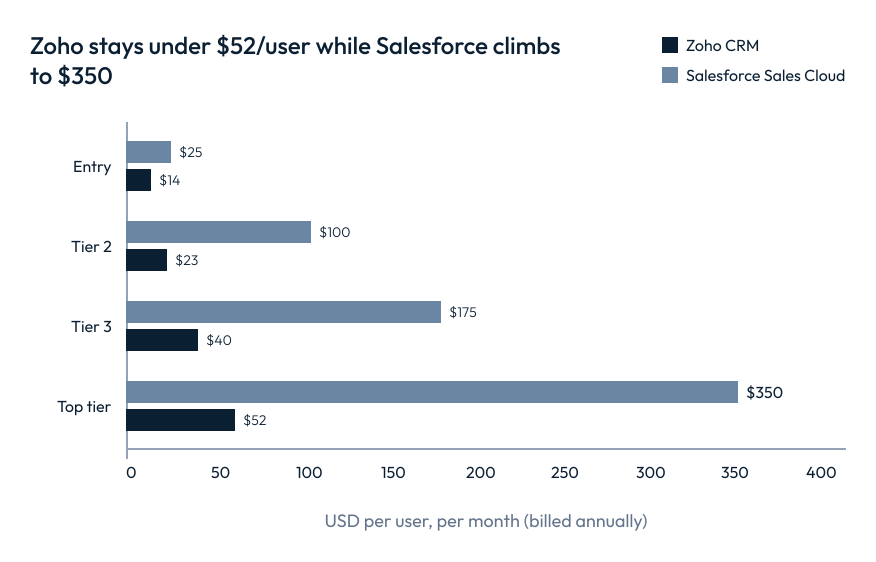
Move up a tier, and the gap is no longer a rounding error. Zoho’s top-of-the-line Ultimate plan runs $52 per user per month, less than Salesforce’s Pro Suite at $100, and about a seventh of Salesforce Enterprise at $175. By the time a growing sales team needs the automation and API access that come standard in Salesforce Enterprise, Zoho has usually already covered equivalent ground at the Professional or Enterprise tier, for a third of the price.
That’s not an argument that Salesforce is overpriced. It’s an argument that the two platforms price for different buyers, and the “cheaper” headline hides how differently the two curves actually bend.
Give Salesforce its due, because most partner-written comparisons don’t. Its AppExchange ecosystem is unmatched, with thousands of pre-built integrations that would otherwise mean custom development. Multi-org enterprises running complex territory management, layered approval chains, and forecasting across dozens of business units genuinely need what Enterprise and Unlimited provide. If your sales org spans multiple countries, multiple currencies, and a headcount in the hundreds, Zoho’s simplicity stops being an advantage and starts being a ceiling.
4.4★ vs 4.2★
Zoho CRM (869 reviews) vs Salesforce (721 reviews).
Source: Gartner Peer Insights, 2026.
The rating gap favors Zoho, but ratings measure satisfaction, not DBU capability ceiling. For the businesses that actually hit that ceiling, Salesforce is worth the premium.
For most small and mid-market teams, though, the calculus flips. Zoho isn’t just a cheaper CRM, it’s the anchor of a suite (Zoho One) covering manufacturing, accounting, inventory, help desk, and analytics under one login, which matters the moment a growing business needs those tools talking to each other instead of living in five separate subscriptions.
It’s also faster to get running. Most teams are working in Zoho within days, not months, without a certified administrator on staff. That matters more than it sounds: the CRM that goes live in a week starts generating pipeline visibility in a week. The CRM that takes a quarter to configure loses three months of forecasting data that nobody gets back.
If a business is shopping for a genuine Salesforce alternative rather than Salesforce itself, that speed and suite breadth are usually the real reason, more than price alone.
Here’s what almost never makes it into a “Zoho vs Salesforce” article: most CRM regret has nothing to do with which platform got picked. It’s what happened to the configuration six months after go-live.
We’ve watched growing teams outgrow their setup and read that as outgrowing the platform, when it was usually a configuration problem, not a Zoho-versus-Salesforce problem.
Teams don’t usually need to migrate off Zoho when they scale. They need to reconfigure it. Migrating to Salesforce because the Zoho instance feels small is treating a symptom as if it were the disease.
We’ve laid out the full breakdown of what that reconfiguration looks like in practice and what to fix before concluding that a business has outgrown the platform in Zoho CRM Scaling: Startup to Enterprise.
That’s the honest version of “which CRM should I pick”: start with what the business needs today, build it properly, and revisit the platform question only after ruling out a configuration fix.
| Scenario | Better fit |
|---|---|
| Team under 50, budget-conscious, need results fast | Zoho |
| Already running other Zoho apps (Books, Desk, Inventory) | Zoho |
| Need CRM live within weeks, no dedicated admin | Zoho |
| Multi-country enterprise, complex approval chains | Salesforce |
| Heavy reliance on niche AppExchange integrations | Salesforce |
| 500+ seat sales org with a Salesforce admin team already in place | Salesforce |
If a business lands on Zoho or isn’t sure and wants a second opinion before committing a budget, that’s exactly the conversation worth having before any implementation starts.
Neither platform is simply “better.” Salesforce is better for enterprise complexity. Zoho is better for speed, price, and suite breadth for most other businesses making this decision. If a second opinion would help before committing a budget, book a consultation. Synkrone8 implements Zoho, and we’ll say plainly if that’s not the right call. For the full feature and pricing breakdown, see our complete guide to Zoho CRM.
For small and mid-market teams, functionally, yes, Zoho covers the sales workflow most teams actually use, at a fraction of the cost. For large multi-org enterprises needing deep customization and a specialized integration ecosystem, Salesforce has more headroom.
Zoho prices for volume across a broad small-business market; Salesforce prices for depth and enterprise support. Zoho tops out around $52/user/month; Salesforce’s Enterprise tier alone runs $175.
Yes, but “outgrowing Zoho” is usually a configuration issue rather than a platform ceiling, worth checking before budgeting for a migration project.
Implementation and admin overhead. Salesforce’s flexibility means most Enterprise deployments need a certified administrator or partner to configure and maintain them, a cost that rarely shows up on the pricing page.
Yes, natively with the 40+ apps in Zoho One, and via API with most accounting, e-commerce, and support platforms, though highly specialized enterprise integrations are where Salesforce’s AppExchange has the edge.
Written by

Synkrone8 is a group of manufacturing IT specialists, ERP consultants, and smart-factory engineers who turn shop-floor challenges into connected, data-driven operations. They write about Industry 4.0, ERP, IIoT, and digital transformation drawn from real implementation experience.
Discover more insights, trends, and stories from our experts.

Zoho
Zoho CRM is a cloud-based customer relationship management system that centralizes sales pipelines, customer contacts,...
12 Min Read
13, Jul 2026

Zoho
Yes, you can scale Zoho CRM from a 5-person startup to a 5,000-seat enterprise without...
9 Min Read
30, Jun 2026

CRM
Manufacturing
Choosing crm software south africa businesses can rely on doesn't start with a vendor shortlist....
6 Min Read
24, Aug 2026